
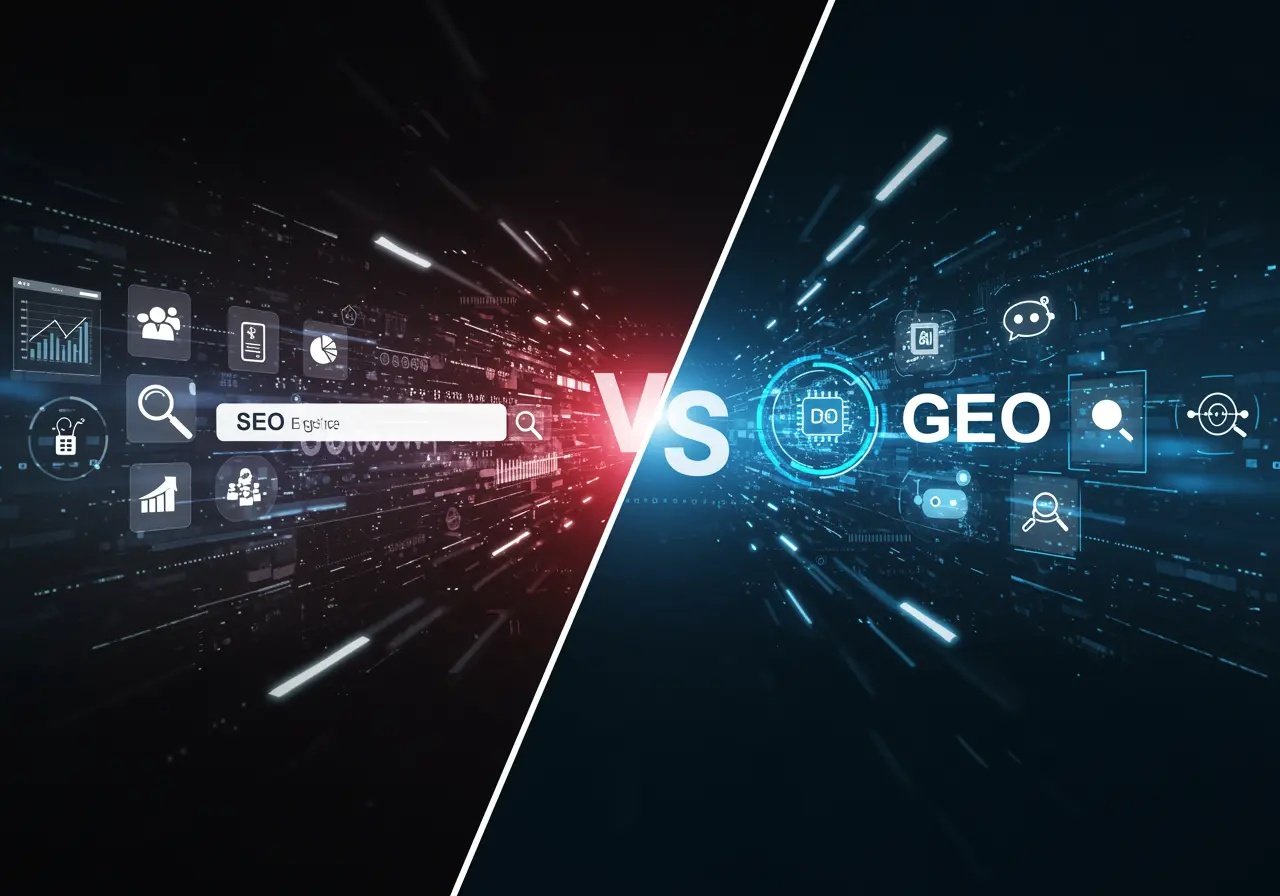
SEO VS GEO – this is very trending topic in digital world and now we have to understand which will be better for your website?
The way people search online is changing faster than ever. Traditional search engines like Google are no longer the only source of information. AI-powered platforms such as ChatGPT, Gemini, and other generative tools are now answering user queries directly.
This shift has introduced a new concept in digital marketing: Generative Engine Optimization (GEO).
If you’re still relying only on traditional SEO techniques, you may already be missing out on a growing share of traffic. In this post, we’ll break down the difference between SEO vs GEO, and how you can rank in AI search engines in future.
What is SEO (Search Engine Optimization)?
Search Engine Optimization (SEO) is the process of improving your website’s visibility on search engines like Google and Bing. The goal is simple: rank higher in search results and drive organic traffic.
Key Elements of SEO:
SEO focuses on ranking web pages based on relevance, authority, and user experience.
- Keyword research and optimization
- On-page SEO (meta tags, headings, internal linking)
- Technical SEO (site speed, mobile-friendliness, crawlability)
- Backlink building
- Content optimization
Example:
When someone searches for “best digital marketing agency in India”, SEO helps your website appear in the top results.
What is GEO (Generative Engine Optimization)?
Generative Engine Optimization (GEO) is the process of optimizing your content so that AI platforms can understand, extract, and present your information directly in answers.
Key Elements of GEO:
Instead of showing a list of links, AI tools provide instant, summarized responses to user queries.
- Context-driven content
- Structured and clear answers
- Semantic relevance (not just keywords)
- Authority and trust signals
- Conversational content format
Example:
When a user asks ChatGPT, “What are the best SEO strategies in 2026?”, the AI may generate an answer using multiple sources instead of listing websites.
SEO vs GEO: The Key Differences
Understanding the difference between GEO and SEO is crucial for staying ahead in digital marketing.
| Factor | SEO | GEO |
| Focus | Ranking in search results | Being featured in AI-generated answers |
| Output | List of links | Direct answers |
| Keywords | Exact match keywords | Semantic and intent-based keywords |
| Content Style | Optimized for bots and users | Optimized for AI understanding |
| Traffic Source | Search engine clicks | AI-driven discovery |
In simple terms:
SEO gets you clicks. GEO gets you visibility inside answers.
Why GEO Matters in Future
AI search is not a trend. It’s a major shift in how users consume information.
1. Zero-Click Searches Are Increasing
Users are getting answers directly without visiting websites. This reduces traditional organic clicks.
2. AI Assistants Are Becoming Default
People now prefer asking AI tools instead of browsing multiple pages.
3. Content Competition is Higher Than Ever
With AI-generated content flooding the internet, only high-quality, structured content stands out.
4. User Intent is More Important
AI focuses on what users mean, not just what they type.
How to Optimize Content for GEO ?
If you want to rank in AI-driven search results, you need to rethink your content strategy.
1. Focus on Search Intent, Not Just Keywords
Traditional SEO focuses on keywords like:
- “best SEO tools”
- “SEO tips”
But GEO focuses on intent:
- “What are the best SEO tools for beginners?”
- “How can I improve my website ranking?”
Use LSI keywords such as:
- AI search optimization
- conversational search queries
- user intent optimization
- semantic SEO
2. Write Clear, Direct Answers
AI prefers content that is:
- Easy to understand
- Well-structured
- Straight to the point
Use:
- Bullet points
- Short paragraphs
- Clear headings (H2, H3)
Example:
Instead of writing long paragraphs, answer questions directly.
3. Use Conversational Content Format
AI tools are trained on natural language. Your content should feel like a conversation.
Include:
- Questions and answers
- “How,” “Why,” and “What” queries
- Simple explanations
This improves your chances of being picked up in AI-generated responses.
4. Build Topical Authority
AI prefers trusted sources. You need to become an authority in your niche.
Do this by:
- Creating content clusters
- Covering topics in depth
- Interlinking related articles
LSI keywords to include:
- content clusters
- topic authority
- niche expertise
5. Optimize for Featured Snippets
Featured snippets are a bridge between SEO and GEO.
If your content appears in snippets, it’s more likely to be used by AI engines.
Tips:
- Answer questions in 40–60 words
- Use structured formats
- Add lists and tables
6. Improve Content Readability
AI prioritizes content that users can easily understand.
Best practices:
- Use simple language
- Avoid jargon
- Keep sentences short
- Maintain a logical flow
7. Add Data, Examples, and Real Insights
Generic content won’t work anymore.
Include:
- Case studies
- Real examples
- Statistics
- Personal insights
This increases your content’s credibility and improves AI trust signals.
8. Use Structured Data (Schema Markup)
Structured data helps AI understand your content better.
Important schemas:
- FAQ schema
- Article schema
- How-to schema
This improves your visibility in both search engines and AI platforms.
How to Combine SEO VS GEO Strategy
The smartest approach is not choosing between SEO VS GEO. It’s combining both.
Hybrid Strategy:
- Use SEO to drive traffic
- Use GEO to gain visibility in AI answers
Practical Approach:
- Start with keyword research (SEO)
- Expand into intent-based queries (GEO)
- Structure content for readability
- Add depth and authority
Example:
- SEO keyword: “digital marketing strategies”
- GEO query: “What are the best digital marketing strategies for small businesses in 2026?”
Common Mistakes to Avoid
Many marketers are still stuck in outdated practices.
Keyword stuffing: AI ignores content that feels unnatural
Writing only for search engines: Your content must serve real users
Ignoring content structure: Unstructured content is harder for AI to understand
Publishing low-value content: Quality matters more than quantity
Future of Search: What to Expect
The future of digital marketing is a mix of AI and human creativity.
Key Trends:
- Voice and conversational search will grow
- AI-generated answers will dominate
- Personalization will increase
- Content quality will become the biggest ranking factor
Businesses that adapt early will gain a strong competitive advantage.
Final Thoughts
The debate of SEO vs GEO is not about replacement. It’s about evolution.
SEO is still important, but it’s no longer enough. To succeed in future, you need to create content that works for both search engines and AI platforms.
Focus on:
- User intent
- Content clarity
- Topical authority
- Real value
If your content truly helps users, AI will recognize it, trust it, and recommend it.
Ready to Rank in Future?
Start optimizing your content not just for Google, but for AI-driven platforms. Because the future of search is already here. Contact Us now.