
Let’s say you’ve been spending months writing great blog posts, service pages and product descriptions. Your website appears professional, your content addresses user questions, and you’ve begun to generate backlinks. But your pages aren’t ranking well in the Google search results.
The problem is often not the content, but the technical groundwork of the website.
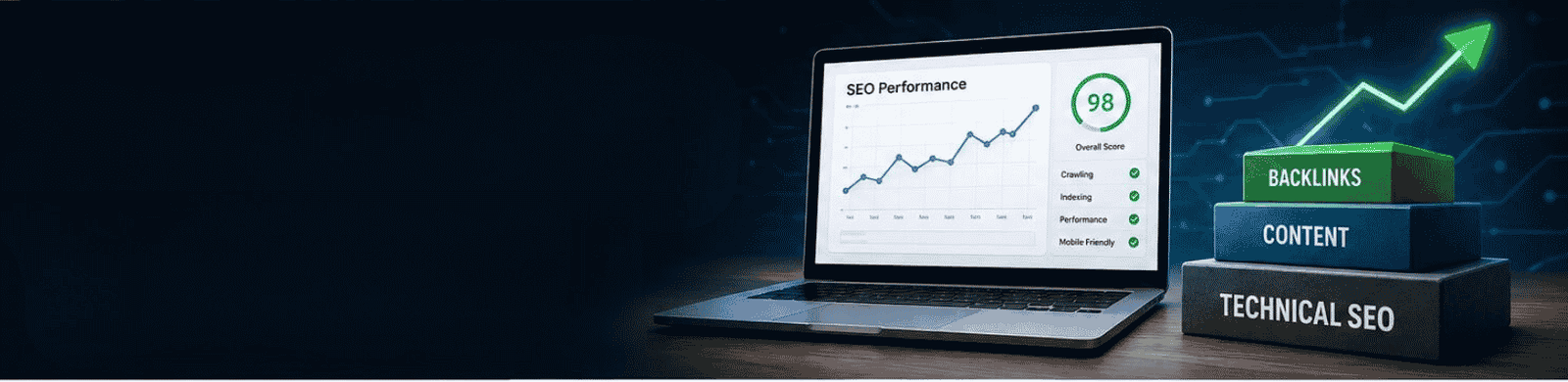
Technical SEO makes sure search engines can crawl, understand and index your website proficiently. Even the best content might never get seen by potential visitors if you don’t have it. Visualise technical SEO as the foundation of the building.
If the foundation is weak, you can’t securely support a beautifully designed house. Similarly, great website content will not be able to reach its search potential if there are technical issues preventing search engines from being able to access or interpret it properly.
Whether you have a business website, e-commerce store, real estate portal, or corporate website, technical SEO has a direct impact on improving search visibility, user experience and long-term organic growth.
How Search Engines Actually Work
Before understanding why technical SEO matters, it’s helpful to know what happens after you publish a page.
Google generally follows three stages:
Step 1: Crawling
Googlebot visits your website by following links, XML sitemaps, and previously discovered URLs.
Example
Suppose you publish:
If this page isn’t linked anywhere on your website and isn’t included in your XML sitemap, Google may never discover it.
Result?
The page exists, but nobody finds it through Google.
Step 2: Indexing
Once Google discovers a page, it evaluates whether the content deserves to be stored in its search index.
Google examines factors such as:
- Content quality
- Duplicate content
- Canonical tags
- Meta robots directives
- Page accessibility
If the page isn’t indexed, it cannot appear in search results.
Step 3: Ranking
Only after indexing does Google decide where your page should rank for different search queries.
If crawling or indexing fails, ranking becomes impossible.
This is exactly why technical SEO is essential.
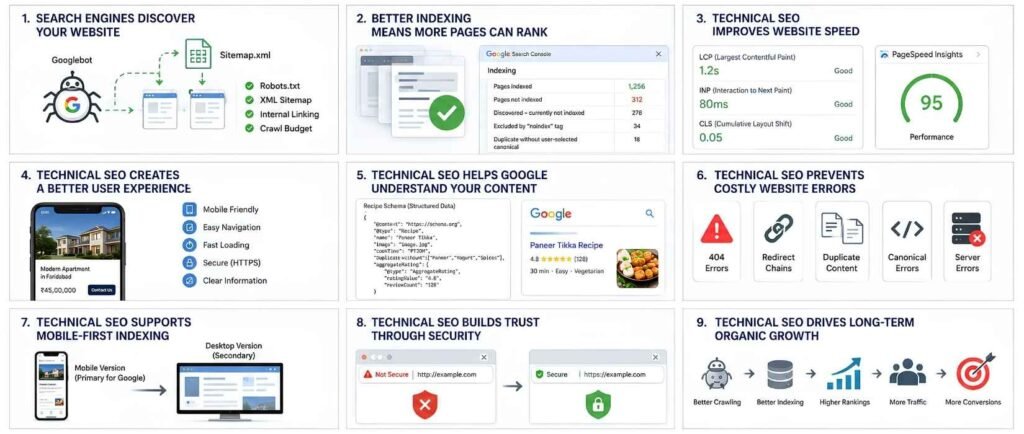
Technical SEO Helps Search Engines Discover Your Website
Search engines cannot rank pages they cannot find.
Many websites accidentally block important pages without realizing it.
Common reasons include:
- Incorrect robots.txt configuration
- Missing XML sitemap
- Broken internal links
- Orphan pages
- Crawl budget wastage
Example
Imagine an online clothing store launches 500 new products.
The developer forgets to update the XML sitemap.
Google only discovers 180 products.
The remaining 320 products never receive impressions because Google doesn’t know they exist.
Although those product pages are live, they generate zero organic traffic.
A properly maintained XML sitemap helps search engines discover new and updated pages more efficiently.
Better Indexing Means More Pages Can Rank
Crawling doesn’t guarantee indexing.
Google may crawl a page and still decide not to index it.
Common reasons include:
- Thin content
- Duplicate pages
- Canonical errors
- Noindex tags
- Soft 404 pages
Real Example
Suppose an e-commerce website has these URLs:
example.com/shoes
example.com/shoes?color=black
example.com/shoes?sort=price
example.com/shoes?utm_source=facebook
These pages display nearly identical content.
Without canonical tags, Google sees multiple versions of the same page and may struggle to determine which one should rank.
By implementing a canonical tag that points all variations to the main product page, you consolidate ranking signals and reduce duplicate content issues.
Technical SEO Improves Website Speed
Website speed affects both user experience and search performance.
Users expect pages to load quickly. Even a few extra seconds can lead to frustration and abandonment.
Google also evaluates performance using Core Web Vitals, including:
- Largest Contentful Paint (LCP)
- Interaction to Next Paint (INP)
- Cumulative Layout Shift (CLS)
Example
Consider two websites offering the same service:
Website A
- Loads in 1.8 seconds
- Optimized images
- Efficient caching
- Minimal JavaScript
Website B
- Loads in 7 seconds
- Large, uncompressed images
- Heavy scripts
- No browser caching
Most users will leave Website B before it finishes loading.
The faster website is more likely to retain visitors, reduce bounce rates, and encourage engagement.
Practical improvements include:
- Compressing images without sacrificing quality
- Serving next-generation formats such as WebP or AVIF
- Enabling browser caching
- Minifying CSS and JavaScript
- Deferring non-critical scripts
- Using a Content Delivery Network (CDN)
- Reducing server response time
Technical SEO Creates a Better User Experience
Google’s objective is to recommend pages that provide value and are easy to use.
Technical SEO contributes by making websites:
- Mobile-friendly
- Easy to navigate
- Secure
- Fast-loading
- Accessible
Example
Imagine you’re searching for “apartments in Faridabad.”
You click two different websites.
Website A
- Fast loading
- Clear navigation
- Filters work correctly
- Images load instantly
- Property details are easy to read
Website B
- Slow loading
- Buttons overlap
- Menus don’t work on mobile
- Broken images
- Pop-ups cover the content
Most users will leave Website B almost immediately.
Technical SEO helps prevent these frustrating experiences.
Technical SEO Helps Google Understand Your Content
Search engines don’t interpret pages exactly as humans do.
Structured data (Schema Markup) provides additional context.
Example
Suppose you publish a recipe.
Without schema, Google sees only text.
With Recipe Schema, Google can identify:
- Cooking time
- Ingredients
- Calories
- Ratings
- Preparation steps
This can lead to enhanced search results with rich snippets, making your listing more prominent.
The same concept applies to:
- Products
- FAQs
- Events
- Articles
- Local businesses
- Reviews
- Organizations
Technical SEO Prevents Costly Website Errors
Even small technical mistakes can have a significant impact.
Examples include:
404 Errors
Users encounter dead pages because the content was deleted or moved.
Example
example.com/seo-guide
returns a 404 error after a site redesign.
Anyone clicking the old URL has a poor experience unless a 301 redirect sends them to the updated page.
Redirect Chains
Instead of:
Page A → Page D
the site has:
Page A → Page B → Page C → Page D
Each additional redirect increases latency and can reduce crawl efficiency.
Duplicate Content
When multiple URLs display the same information, Google may split ranking signals across them, making it harder for any single page to perform well.
Technical SEO Supports Mobile-First Indexing
Google primarily evaluates the mobile version of your website.
A desktop site that works perfectly isn’t enough if the mobile experience is poor.
Example
A real estate website displays:
- Property images
- Pricing
- Contact form
- Location map
On desktop, everything looks great.
On mobile:
- Images overflow the screen
- Buttons are too small to tap
- Text is unreadable
- Contact form doesn’t submit
Google recognizes these usability issues, and users are likely to leave before converting.
Responsive design, touch-friendly navigation, and optimized mobile performance are essential.
Technical SEO Builds Trust Through Security
Users expect websites to be secure, especially when submitting personal information.
HTTPS encryption protects data and signals trust.
Example
Imagine entering your phone number on a website that displays:
“Not Secure”
Many visitors will abandon the form immediately.
Migrating to HTTPS and maintaining a valid SSL certificate helps create confidence and protects user data.
Technical SEO Drives Long-Term Organic Growth
Unlike short-term marketing tactics, technical SEO lays the groundwork for sustainable growth.
A technically optimized website allows:
- New pages to be discovered more quickly
- Existing pages to retain visibility
- Search engines to crawl efficiently
- Future content to perform better
- Site expansions and redesigns with fewer SEO risks
Example
A business publishes 20 optimized blog posts every month.
If indexing problems prevent half of them from entering Google’s index, months of work deliver little value.
Fixing the technical issues ensures that every new piece of content has a genuine opportunity to rank.
Common Signs Your Website Needs Technical SEO
Your website may require a technical SEO audit if you notice any of the following:
- Important pages aren’t appearing in Google Search.
- Organic traffic has declined without a clear reason.
- Google Search Console reports indexing or crawl errors.
- The site loads slowly on mobile devices.
- Core Web Vitals scores are poor.
- Broken links and 404 errors are increasing.
- Duplicate content warnings appear.
- Rich results are missing despite relevant content.
- Users frequently abandon pages before interacting.
These symptoms often indicate underlying technical issues rather than content problems.
Technical SEO is not about chasing algorithms or exploiting shortcuts. It is about making your website accessible, efficient, and understandable for both search engines and users.
Strong content, authoritative backlinks, and effective keyword targeting remain essential, but they all depend on a technically sound website. When search engines can crawl your pages efficiently, index the right content, understand its context, and deliver a fast, secure experience to users, every other SEO effort becomes more effective.
If you want sustainable organic growth, think of technical SEO as the infrastructure that supports your entire digital marketing strategy. Investing in it today can prevent hidden issues from limiting your visibility tomorrow.